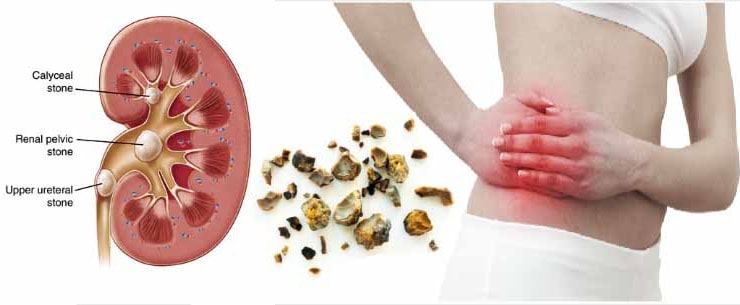
RIRS and PCNL are minimally invasive kidney stone removal procedures. RIRS removes stones by inserting a ureteroscope through the urethra and guiding it all the way up to the kidney through your urinary tract. PCNL accesses the kidneys through a direct incision in the skin.
RIRS vs PCNL: Which Kidney Stone Surgery Is Best?
Small kidney stones can pass on their own through the urine. A kidney stone specialist in Navi Mumbai may recommend increasing your fluid intake to around 2-3 liters of water a day, which may dilute the urine and flush out the stones naturally. Pain relief medication may be needed if the stones cause severe pain in the back or sides.
Sometimes, doctors prescribe alpha-blockers to relax muscles in your ureters, encouraging stones to pass smoothly with less pain. However, if nothing works, or the stones are too large to leave your body naturally, invasive treatments may be necessary. Two popular options include RIRS (Retrograde Intrarenal Surgery) and PCNL (Percutaneous Nephrolithotomy).
What is Retrograde Intrarenal Surgery (RIRS)?
This modern surgical procedure involves guiding a thin, flexible tool (ureteroscope) through the urethra, bladder, and ureters to reach the kidneys.
Once the stones are located, a laser breaks them into smaller fragments, which are either removed with specialized instruments or left in the kidneys to pass naturally. The surgeon may place a stent temporarily to allow urine drainage from the kidneys directly to the bladder, allowing the ureter time to heal.
While RIRS is a minimally invasive surgical approach, it’s not suitable for all. For kidney stones located in complex, hard-to-reach areas, or those larger than 2-3 cm, RIRS may not be an appropriate treatment choice.
What is Percutaneous Nephrolithotomy (PCNL)?
PCNL is another minimally invasive kidney stone treatment in Navi Mumbai that uses a different approach to reach the kidney. Instead of going up the urinary tract, the surgeon accesses your kidneys through a small incision (around 1 cm).
The incision is made in the skin at the back. The surgery is performed under anesthesia, so you won’t feel anything during the procedure. They place a sheath through this incision, guiding it to the kidney.
Through this sheath, the surgeon introduces a nephroscope, a tool to get a clear view of the stones in the kidney. The smaller stone can be removed in one piece through the same channel, while larger ones are broken down into small pieces with a laser and removed. It also involves a temporary stent placement for urine drainage.
RIRS Vs PCNL: Which is Better?
Both are effective, minimally invasive kidney stone removal procedures. The best procedure for you depends on the stone size, location, and your overall health.
RIRS seems like a reasonable treatment choice for small or moderate stones that do not pass naturally through the urinary tract. It’s mainly attractive because it doesn’t involve skin incision and has a relatively shorter recovery period than PCNL.
That said, the stone’s size alone doesn’t make RIRS a suitable option. Your surgeon may consider stone location, density, numbers, and your kidney anatomy before deciding on an appropriate treatment
PCNL is for larger stones. Since it provides direct access to the kidneys, stones can be visualized, broken down, and removed safely through the access site.