Dr.Dey

Kidney Cancer

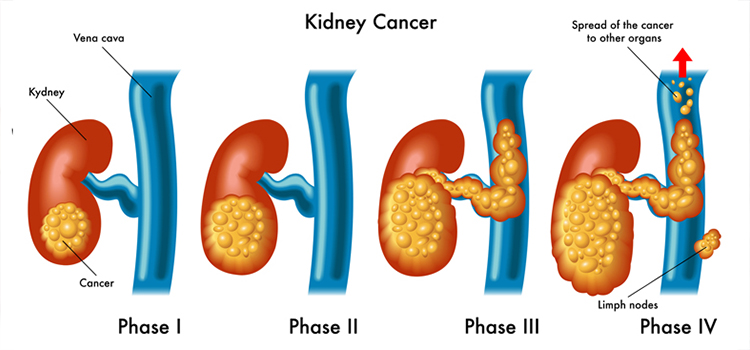
Kidney Cancer Stages

Survival Rates for Kidney Cancer

Survival Rates of Kidney Cancer Almost every patient who is diagnosed with the cancer wants to know about his survival rate. So, the patients generally ask the doctor about their survival rate. They can’t tell you exactly how long you will live, but they may help give you a better understanding of how likely it is that your treatment will be successful. A relative survival rate compares people with the same type and stage of kidney cancer to people in the overall population. For example, if the 5-year relative survival rate for a specific stage of kidney cancer is 80%, it means that people who have that cancer are, on average, about 80% as likely as people who don’t have that cancer to live for at least 5 years after being diagnosed. Localized: There is no sign that the cancer has spread outside of the kidney. As long as the tumour is within the kidney the five years survival rate of the patients rise to somewhere between 80-90%. And in the same case if the size of the tumour is around 4-7 cm it will rise up to 90-100%.   But if the size is more than 10 cm the survival rate decreases to 70%. so as long as the tumour is inside the kidney the survival rate may lie between 70-90%. Regional: The cancer has spread outside the kidney to nearby structures or lymph nodes. Now, if the tumour is spread to other parts of body the 5-year survival is only 10% i.e., only 10 out of 100 patients will survive for 5 years. If the tumour has spread to the lymph node, then the survival rate rises to 20%. Distant: Includes cancers that have spread to distant parts of the body such as the lungs, brain, or bones. And the survival rate is somewhere around 20-30%.  Now a days with the advancement of technology if the thrombosis is below the level of diaphragm, then 50% of patient will survive more or up to 5 years. So, kidney tumours that are less than 4 cm they can be removed and the survival rate will be approximately 100%. With size decreases the survival rate and if the tumour has spread outside the kidney the survival rate decreases.  People now being diagnosed with kidney cancer may have a better outlook than these numbers show. These numbers apply only to the stage of the cancer when it is first diagnosed. They do not apply later on if the cancer grows, spreads, or comes back after treatment. These numbers don’t take everything into account. Keep in mind that survival rates are estimates and are often based on previous outcomes of large numbers of people who had a specific cancer, but they can’t predict what will happen in any particular person’s case. These statistics can be confusing and may lead you to have more questions. Your doctor is familiar with your situation, so ask how these numbers may apply to you. Dr Soumyan Dey is a Best Uro Oncologist who is best kidney cancer surgeon in Mumbai follows a evidence based approach to identify the best course of Kidney Cancer treatment. 

Kidney cancer treatment

How fast does kidney cancer spread

How Fast Does Kidney Cancer Spread? Kidney cancer is the cancerous growth in your kidneys. It starts with a few cells that multiply in large numbers rapidly and spread within and outside the kidneys. These quickly multiplying cells might form a mass. Kidney cancer that spreads to the nearby organs is called metastatic cancer or cancer in its IV stage. Renal cell carcinoma, the most common type of kidney cancer, has many subtypes. The rate at which the cancer cells spread depends largely on how aggressive the cancer is. The cells usually spread to the lymph nodes and lungs, but they can also go beyond that, depending on the type of cancer. Chromophobe, capillary, and clear cells are the most common subtypes of kidney cancer. Of these, the clear cell is the most aggressive one. A vast majority of kidney cancer patients are diagnosed with clear cell renal carcinoma, which spreads aggressively across your kidneys and other vital organs. In addition to the lungs, the cells might spread to your liver and bones too. Chromophobe is less likely to occur and has only a 7% chance of spreading to the surrounding tissues. How does Renal Cell Carcinoma Spread? As cancer starts spreading, it enters your bloodstream. It can also reach the adrenal gland found right on top of the kidneys. Once these cells reach your blood vessels, they are transferred to your veins and arteries. Your lymph nodes are connected to your entire body and are primarily responsible for fighting infections. But, once these get infected with the cancer cells, they might weaken, affecting your body’s ability to cope with infection. As mentioned before, cancer most likely spreads to your lungs first, but it can reach your brain, liver, and other vital organs. The worst part is that renal carcinoma rarely produces symptoms in the early stages. Even if it does produce symptoms, these are often confused with infections and other conditions. That’s why kidney cancer is associated with a high mortality rate and is one of the most difficult to treat. It often goes unnoticed in the first few stages. Cancer starts in the tubules. They multiply rapidly within the kidneys and grow to form a mass or a tumor. It can spread the nearby organs in multiple ways. The cells usually invade the nearby blood vessels and then enter your lymph nodes, through which these are carried to other parts of your body. The survival rate for kidney cancer patients depends on how aggressively the cancer has spread. If the metastasis is confined to the lungs and kidney, there is a good chance of 5-year survival.  Treatment for Kidney Cancer The treatment also depends on where cancer has spread and the size of the tumor. If the cancer is within the kidney, chemotherapy in conjunction with surgical removal of the tumor is recommended. You may need radiation therapies with complete or partial removal of the kidney if cancer has spread beyond that. The surgeon might also remove tissues and lymph nodes affected by these cells. If you are facing any symptoms of Kidney related issues or found Cancer in your Kidney, you must consult Dr Soumyan Dey, Best Uro Oncologist in Mumbai

Scroll to Top