
Laser Prostatectomy for 200cc Enlarged Prostate in an 80-Year-Old Patient
Introduction
Benign Prostatic Hyperplasia (BPH), commonly known as enlarged prostate, is a condition where the prostate gland increases in size and may block normal urine flow.
When the prostate becomes significantly enlarged, patients may experience difficulty passing urine, frequent urination, poor urinary flow, and bladder-related symptoms.
This clinical case highlights the management of a very large prostate measuring approximately 200 cc using laser prostatectomy, providing a minimally invasive alternative to traditional open prostate surgery.
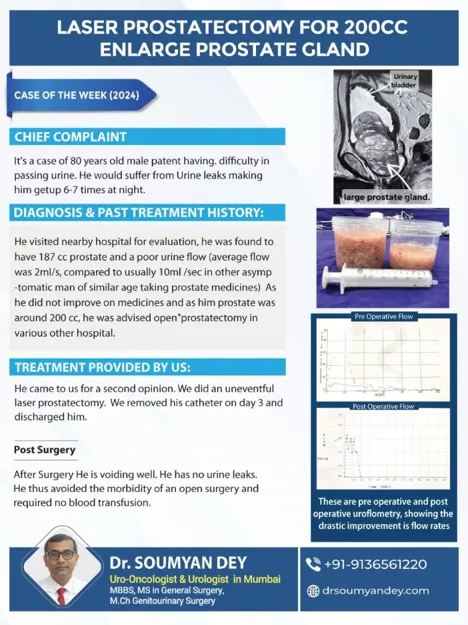
Case Overview
Patient Profile
- Age: 80 years
- Gender: Male
Condition Treated
Severely Enlarged Prostate (Benign Prostatic Hyperplasia)
Prostate Size
Approximately 187–200 cc
Procedure Performed
Laser Prostatectomy
Clinical Presentation
The patient presented with:
- Difficulty passing urine
- Urine leakage
- Frequent night-time urination (6–7 times per night)
The symptoms were affecting daily life and urinary function.
Diagnosis and Previous Treatment History
The patient underwent evaluation at another hospital and was found to have:
- Prostate size of approximately 187 cc
- Poor urinary flow
The average urine flow was around:
2 ml/sec
(compared with approximately 10 ml/sec in a similar age group without significant obstruction)
The patient had already tried prostate medications but did not experience adequate improvement.
Due to the large prostate size, open prostatectomy was suggested at other centres.
Treatment Approach
Laser Prostatectomy
The patient visited Dr. Soumyan Dey for a second opinion.
A laser prostatectomy was performed to remove the obstructing prostate tissue and improve urinary flow.
Laser prostate surgery uses a scope inserted through the urinary passage to remove excess prostate tissue causing blockage.
The procedure helped avoid the need for traditional open prostate surgery.
Key Highlights of the Case
- 80-year-old patient with severe urinary symptoms
- Very large prostate measuring approximately 200 cc
- Poor urinary flow despite medication
- Laser prostatectomy performed successfully
- Avoided traditional open prostate surgery
- Improved urinary function after surgery
Benefits of Laser Prostatectomy
The laser approach provided benefits including:
- Minimally invasive treatment
- Avoidance of large surgical incision
- Reduced surgical trauma
- No requirement of blood transfusion
- Faster recovery
Laser procedures are often considered for enlarged prostate cases because they can effectively remove obstructing tissue with less bleeding compared with some traditional approaches.
Post-Operative Outcome
Following surgery:
- Catheter was removed on day 3
- Patient was passing urine well
- No urine leakage was reported
- Open surgery was avoided
- No blood transfusion was required
The patient showed improvement in urinary function after treatment.
Understanding Enlarged Prostate (BPH)
An enlarged prostate can press against the urethra and obstruct urine flow.
Common symptoms include:
- Weak urine stream
- Difficulty starting urination
- Frequent urination
- Night-time urination
- Feeling of incomplete bladder emptying
- Urine leakage
Treatment depends on prostate size, symptoms, urinary flow, and overall health.
Frequently Asked Questions
What is an enlarged prostate?
An enlarged prostate, also called benign prostatic hyperplasia (BPH), is a non-cancerous increase in prostate size that may affect urine flow.
Can a 200cc prostate be treated with laser surgery?
In selected patients, laser prostate procedures may be used for very large prostates depending on clinical evaluation and surgical suitability.
What are the symptoms of a very large prostate?
Symptoms may include difficulty passing urine, weak flow, frequent urination, night-time urination, and urinary leakage.
Is laser prostatectomy different from open prostate surgery?
Yes. Laser prostatectomy is a minimally invasive procedure performed through the urinary passage, while open prostate surgery requires an external incision.
Why is urine flow testing important in enlarged prostate?
Urine flow measurement helps doctors understand the severity of blockage and evaluate treatment requirements.
Related Treatment
Enlarged Prostate Treatment
Large prostate enlargement requires accurate assessment and personalised treatment planning.
Dr. Soumyan Dey provides advanced treatment options for enlarged prostate conditions, including minimally invasive surgical approaches.
Suffering From Enlarged Prostate Symptoms?
Timely evaluation can help prevent complications caused by urinary obstruction.
Dr. Soumyan Dey provides expert diagnosis and advanced treatment options for enlarged prostate conditions.