
Large Bladder Stone Causing Urinary Obstruction Treated with Cystolithotomy
Introduction
Bladder stones are hard mineral deposits that develop inside the urinary bladder and can cause difficulty in passing urine, pain, infections, and urinary obstruction if left untreated.
While smaller bladder stones may sometimes be managed with minimally invasive procedures, very large stones can require advanced surgical treatment.
This clinical case highlights the management of a giant bladder stone measuring 12 × 10 cm and weighing approximately 0.5 kg, which caused severe urinary obstruction and affected kidney drainage.
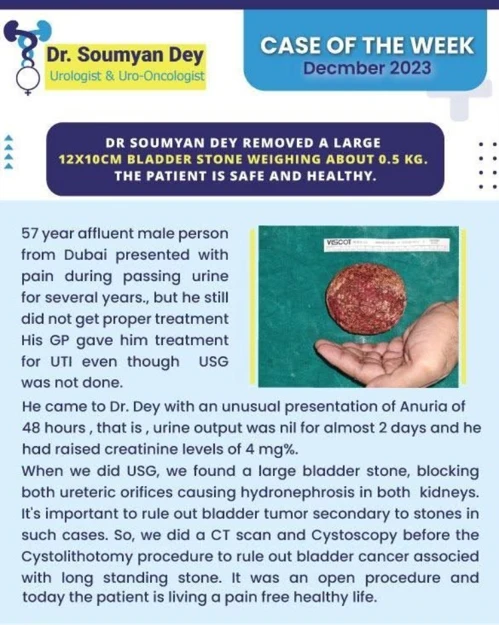
Case Overview
Patient Profile
Age: 57 years
Gender: Male
Location: Dubai
Condition Treated: Large Bladder Stone
Stone Size: 12 × 10 cm
Approximate Weight: 0.5 kg
Procedure Performed: Cystolithotomy (Surgical Bladder Stone Removal)
Clinical Presentation
The patient had been experiencing pain while passing urine for several years.
Despite ongoing symptoms, he did not receive proper evaluation earlier and was treated for urinary infection.
The patient later presented with an unusual and serious condition:
No urine output for approximately 48 hours (Anuria)
Raised creatinine level of 4 mg%
Further investigation was required to identify the underlying cause of urinary blockage.
Diagnosis and Evaluation
Ultrasound evaluation revealed a large bladder stone causing obstruction.
The stone was found to be blocking both ureteric openings, resulting in:
Obstruction of urine drainage
Hydronephrosis (swelling of both kidneys)
Due to the long-standing nature of the stone, further evaluation was performed.
The patient underwent:
CT Scan
Cystoscopy
These investigations were performed to assess the condition and rule out associated bladder abnormalities, including possible bladder tumors related to chronic stone irritation.
Treatment Approach
Cystolithotomy for Large Bladder Stone Removal
Considering the size and complexity of the bladder stone, the patient underwent cystolithotomy.
Cystolithotomy is a surgical procedure performed to remove large bladder stones that cannot be effectively managed through smaller procedures.
During the procedure:
The bladder is accessed surgically
The stone is removed completely
Urinary passage is restored
Key Highlights of the Case
Large bladder stone measuring 12 × 10 cm
Stone weighing approximately 0.5 kg
Caused blockage of both ureteric openings
Resulted in swelling of both kidneys
Patient presented with complete absence of urine output for 48 hours
Required surgical bladder stone removal through cystolithotomy
Understanding Large Bladder Stones
Bladder stones may develop due to factors such as:
Difficulty emptying the bladder completely
Urinary obstruction
Recurrent urinary infections
Long-standing bladder conditions
Common symptoms may include:
Pain while passing urine
Difficulty urinating
Frequent urinary infections
Blood in urine
Sudden urinary blockage
Early diagnosis can help prevent complications involving the kidneys and urinary system.
About Cystolithotomy
Cystolithotomy is a surgical technique used for removing large bladder stones.
It may be considered when:
The stone size is very large
The stone causes urinary obstruction
Other treatment options may not be suitable
The treatment approach depends on the patient’s condition, stone characteristics, and overall health.
Related Treatment
Urology Treatment
Large bladder stones and urinary obstruction require proper diagnosis and specialised management. Dr. Soumyan Dey provides comprehensive urological care for complex urinary tract conditions.
Frequently Asked Questions
What is a bladder stone?
A bladder stone is a hard deposit formed inside the urinary bladder due to mineral accumulation in urine.
Can bladder stones cause kidney problems?
Yes, large bladder stones can block normal urine flow and may affect kidney drainage, leading to complications such as hydronephrosis.
What is cystolithotomy?
Cystolithotomy is a surgical procedure used to remove large bladder stones through an opening made in the bladder.
Are large bladder stones treated differently from small stones?
Yes. Treatment depends on the size, location, symptoms, and complexity of the stone. Very large stones may require surgical removal.
Why are long-standing bladder stones evaluated carefully?
Long-standing stones can cause chronic irritation and urinary complications, so proper assessment is important.
Need Expert Evaluation for a Bladder or Urinary Problem?
Dr. Soumyan Dey provides specialised evaluation and treatment for complex urological conditions using advanced surgical approaches.