
Dr.Dey

robotic surgery urologist

Is-Nephrectomy-the-Best-Treatment-for-Renal-Cell-Carcinoma

Is Nephrectomy the Best Treatment for Renal Cell Carcinoma?

Renal cell carcinoma affects hundreds of thousands of people worldwide. Kidney cancer sounds intimidating. However, cutting-edge technology has made many advanced treatment options possible for those diagnosed with this malignant cancer.  A common question that people ask is whether nephrectomy surgery is their only hope. Or, is it the best kidney cancer treatment in Vashi, Navi Mumbai? The answer depends on the type of cancer, how far it’s spread, the size of the tumor, and your health. Let’s learn more about it. Causes of Renal Cell Carcinoma RCC starts in the tubules that filter blood and produce urine. Although the exact causes are unknown, certain risk factors that are believed to contribute to an increased risk of RCC include: Symptoms of RCC are often not obvious in the early stages. It may be detected accidentally during routine check-ups or imaging tests. Symptoms might show up later, i.e., when the disease has progressed.  Symptoms usually depend on the parts of the body the cancer has affected. Patients report blood in the urine, weight loss, fatigue, pain in the back, and an unusual mass in the abdomen. Nephrectomy for Renal Cell Carcinoma Nephrectomy is a surgery to remove the diseased kidney (sometimes, a part of it) to get rid of cancer. Your surgeon might recommend: Partial Nephrectomy If the cancer affects only a small portion of the kidney, the oncologist might remove the diseased part, leaving the healthy kidney tissues intact. Choose the best urologist in Vashi, Navi Mumbai, if you want to preserve your kidney function with partial nephrectomy. Radical Nephrectomy Radical nephrectomy removes the entire kidney and is the most preferred choice for patients with a large tumor, a tumor located in the center of the kidney, or when the cancer cells have metastasized to the lymph nodes and the surrounding structures. Depending on the stage of the RCC, the entire kidney, including lymph nodes, adrenal gland, and surrounding tissues, is removed. If the cancer is localized (i.e., it hasn’t invaded the nearby tissues or organs), surgery may be the most effective treatment plan. However, nephrectomy alone may not always be a practical option. For example, people with advanced-stage RCC may require targeted therapy, immunotherapy, or a mix of both for the best results. If the patient’s kidneys aren’t healthy or functioning properly, removing them may worsen their condition. In such cases, cryotherapy or radiofrequency ablation (RFA) can help destroy the cancer. Chemotherapy is not used as a primary treatment for kidney cancer, as kidney tumors are resistant to chemotherapy drugs, making it less effective than other treatment options, like immunotherapy. Conclusion  While nephrectomy is used as the first line of treatment for most renal cell carcinoma cases, surgery alone may not be effective if the cancer has metastasized. That said, there’s no one-size-fits-all treatment for kidney cancer. Some patients may find relief from a combination of treatment options, while others may experience improvement with surgery alone.

Single-Incision Laparoscopic

Is Single-Incision Laparoscopic Kidney Removal a Safer and Less Painful Procedure?

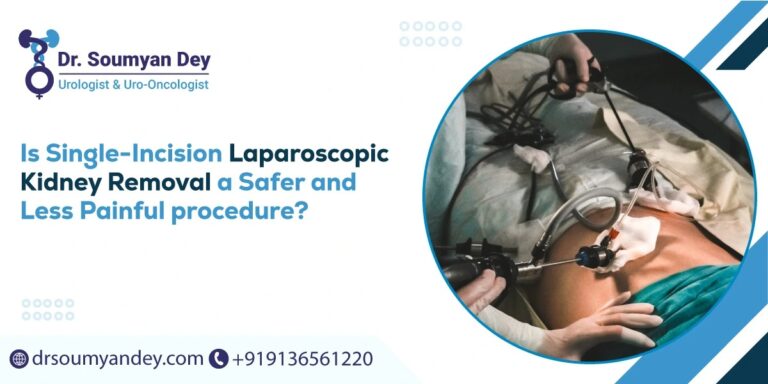
Laparoscopic surgery has evolved. This minimally invasive approach has been chosen by most patients who are advised to undergo a kidney removal surgery in Vashi, Navi Mumbai. The minimal scarring, less post-operative pain, and fewer incisions are some key benefits of the approach.  A recent advancement in the technique is the single-incision laparoscopy for nephrectomy. Instead of making multiple incisions on your abdomen, the surgeon creates only a single small incision around the belly button, making the surgery safer, less painful, and easier on your body. Here’s all you should know about it. When is Single-Incision Laparoscopic Kidney Removal Recommended? Here’s when single-incision laparoscopic kidney removal is needed. Kidney Cancer: Surgery is needed if you are diagnosed with kidney cancer. The exact treatment plan depends on how fast the cancer spreads or the level of damage it has caused. If it’s an initial-stage cancer, the entire kidney might be removed with laparoscopic surgery to reduce the risk of the cancer spreading. Non-functioning Kidney: If one of your kidneys doesn’t function optimally, is infected, or has congenital defects, removing it with nephrectomy surgery can be an ideal decision.  Donor Nephrectomy: People who donate their kidneys can also undergo single-incision nephrectomy to ensure better post-operative outcomes, lesser pain, and no major scars.  What are the Benefits A urologist in Vashi, Navi Mumbai, can remove your kidney through SILS. You might wonder how it is different from open surgery or typical multiple-incision laparoscopic nephrectomy. Here is how it’s a better alternative to other nephrectomy procedures: Minimal Scarring: The biggest advantage of SILS is minimal scarring. The incision length is 2-4 cm and is either in the navel or close to it. If you are concerned about a 10-12 cm long scar from an open surgery or multiple small scars in a laparoscopic procedure, this could be your best option.  Reduced Pain: A single, small scar means less post-operative pain. Your surgeon doesn’t have to make big cuts on the muscles and tissues, which reduces the pain levels significantly. As a result, you don’t have to take stronger pain medications. This also means you can walk, move, laugh, and transition to your pre-surgery life quickly. Quicker Recovery: You can also resume your routine tasks sooner and get back to work faster compared to the longer recovery periods of traditional open surgery. You can expect a discharge in 1-2 days and can perform light activities in a week (if your doctor clears you for it). Full recovery can be expected in 4-6 weeks. Reduced Risk of Complications: In SILS, there’s only one entry point. Fewer incisions mean a lower risk of infection, bleeding, or hernias. Besides, a single incision makes wound care easier for the patient.SILS is a modern, innovative surgical approach for nephrectomy. It’s ideal for people donating their kidneys or needing to detach them due to medical reasons. The success rate of the procedure depends on many factors, such as the surgeon’s expertise and your health, but overall, it’s a highly preferred and smart alternative to traditional nephrectomy procedures.

Robotic Surgery in Urology

Why is Robotic Surgery in Urology Essential?

Urology encompasses the delicate parts of the body, including the kidneys, bladder, urethra, and male reproductive organs. If surgery is recommended, it should be performed by the best uro-oncologist and robotic surgeon in Vashi, Navi Mumbai, to minimize the risk of accidental damage to surrounding tissues and organs.  What once looked futuristic has now gone mainstream. Robotic surgery has proven to be a successful treatment tool for urological surgical procedures, and it\’s not hard to see why. In this post, we\’ve explored the top reasons why robotic surgery in urology is essential. Here\’s a look: What Is Robotic Urologic Surgery? Robotic surgery doesn\’t imply a robot performing surgery. A professional sits at the console, commands the robotic arm that holds all the essential surgical tools and executes the surgery.  The key difference lies in the fact that robotic hands are used to reach tricky, restricted areas. In other words, the surgeon maneuvers the robotic arm to achieve better control and precision. Urologic surgery is widely preferred for these procedures: Why Use Robotic Surgery in Urology? Here\’s what makes robotic surgery in urology a better alternative to traditional surgery: Allows Access to Tight Spaces The urinary tract includes organs that are located in restricted areas. They are surrounded by nerves, muscles, and tiny blood vessels, which can be hard to navigate. Robotic urology surgery in Navi Mumbai has enabled surgeons to perform the most challenging urological procedures while ensuring minimal to no damage to healthy tissues. Excellent Precision Robots are designed to bend, twist, and move seamlessly in narrow and tight spaces, offering unparalleled precision. For delicate areas, such as your kidneys, sphincter muscles, and bladder, surgical precision is indispensable. Robotic arms allow smooth movements with minimal risk of damage to the adjacent tissues and nerves. Faster Recovery Open urology surgery involves large cuts, a risk of excessive blood loss, and longer recovery times. This can extend your hospital stay. You may also need to take painkillers for a prolonged period. With robot-assisted urological surgery, you can expect a discharge in 2-3 days or sooner for simple procedures. Improved Surgical Clarity with 3D Imaging A clear view of the surgical site improves accuracy during the surgery. This can\’t be achieved with human eyes. Improved surgical clarity means more favorable surgical outcomes for the patient. Robotic surgery is not just a fancy or luxury procedure. With the level of precision it offers, it\’s become mandatory in healthcare facilities offering urology care. It makes sense to see a urologist who specializes in using robotic tools for invasive treatment requirements.

Scroll to Top